Vocabulary activities for online ESL lessons that stick
Ten vocabulary activities for online ESL lessons, A1 to B2, built on retrieval and recycling so new words are still there next lesson.
By Gomently Team7 min read


Your student nods at the new word list on Monday. By Thursday, half of it is gone. If that sounds familiar, the problem is rarely the words. It is how often, and how hard, the student has to pull them back out.
How do you make new vocabulary stick in online lessons?
Students remember the words they have to retrieve from memory several times, in different ways, across more than one lesson. Rereading a list feels like learning, but recalling a word with a little effort is what makes it last.
A small paper on eight A1 adult learners describes exactly this kind of routine: classes opened with varied recall tasks revisited over four months, where learners did "word search puzzles, anagram-solving tasks, matching exercises, image labeling, guided writing frames, and online audio-based quizzes." It is one small study, but the shape is useful.
The ten ideas below follow one cycle: meet the word, match it, use it, hear and say it, then review it later. Each idea says where it sits.

1. Match the word to its picture or meaning
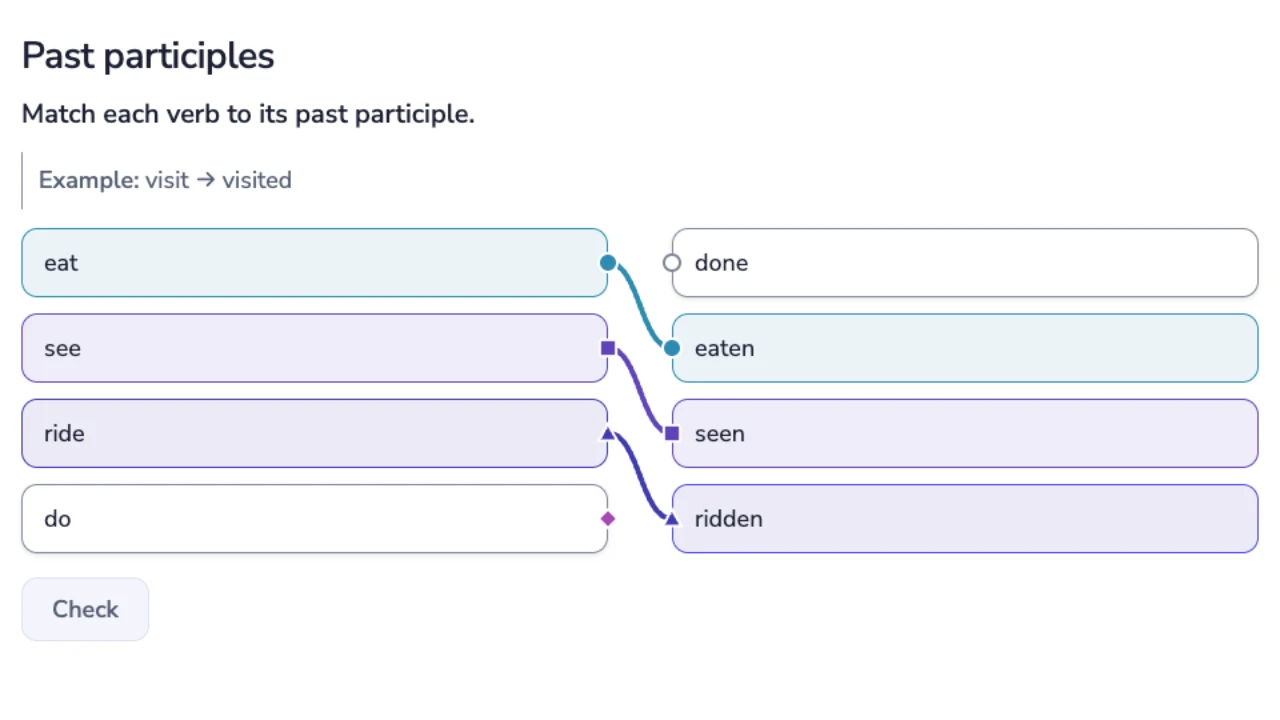
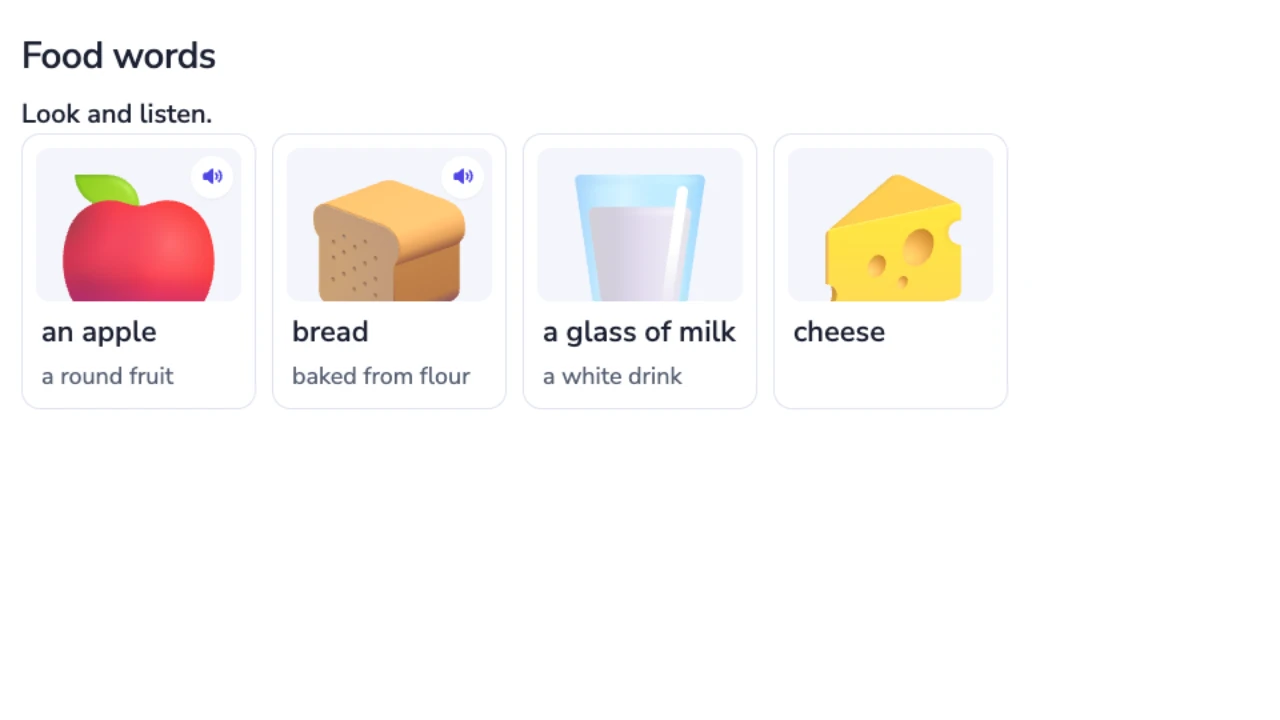
Cycle: match. At A1, pair food words with pictures: bread, apple, cheese, rice. At B1, pair phrasal verbs with definitions: give up with "stop trying", put off with "do later".
Why it works: it is a first retrieval with low pressure. The answer is on the screen, but the student still has to find it.
One to one: the student matches, then says each pair aloud to you. Group: each student matches on their own screen, then compare answers and talk about the one most people got wrong.
Variation: match collocations. Make goes with a decision, a mistake, a plan. Do goes with homework, the dishes, your best.
2. Gap fills with a word bank, then without one
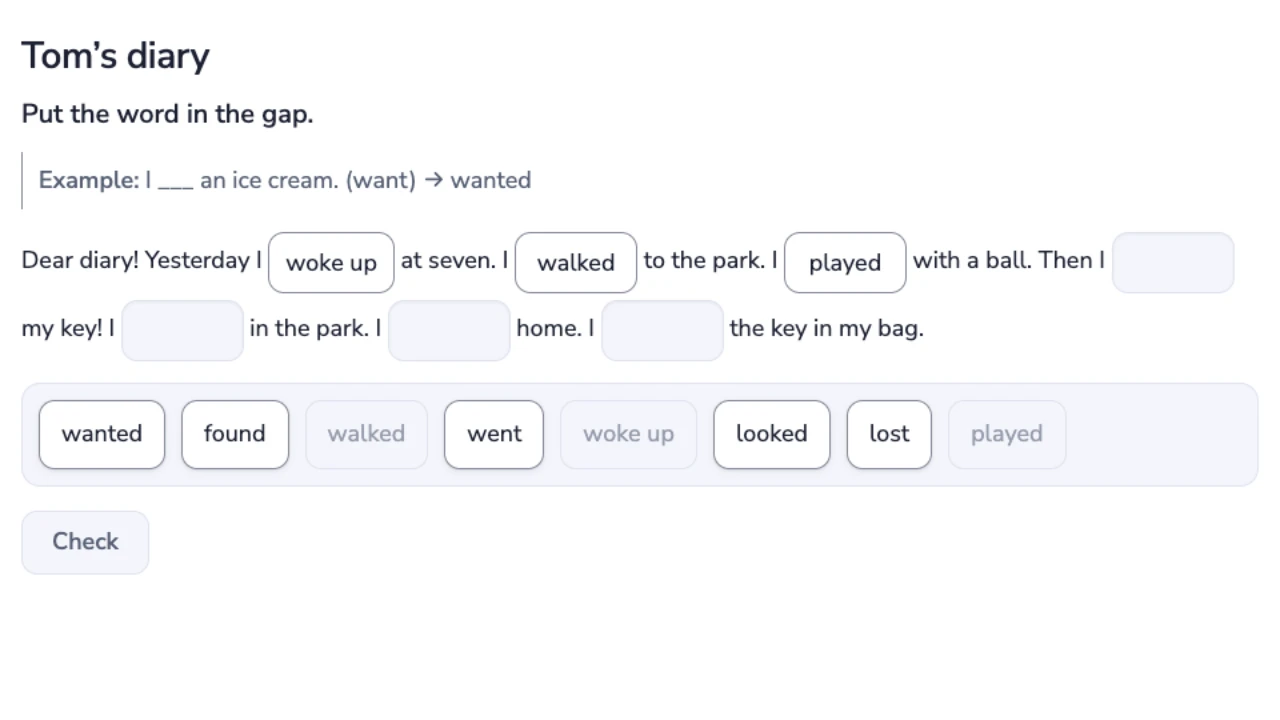
Cycle: use. At A2, write a short postcard: "It is sunny in the morning, but in the afternoon it is windy and cloudy." Leave the weather words as gaps.
Why it works: moving from choosing to typing makes recall harder, and harder recall is stronger.
Run the word bank version early in the lesson. At the end, give the same text with no bank and ask students to type the words.
Variation: use dropdown gaps for confusable pairs. "Can I borrow / lend your pen?" "Can you borrow / lend me ten pounds?"
3. Sort words by meaning, feeling or sound
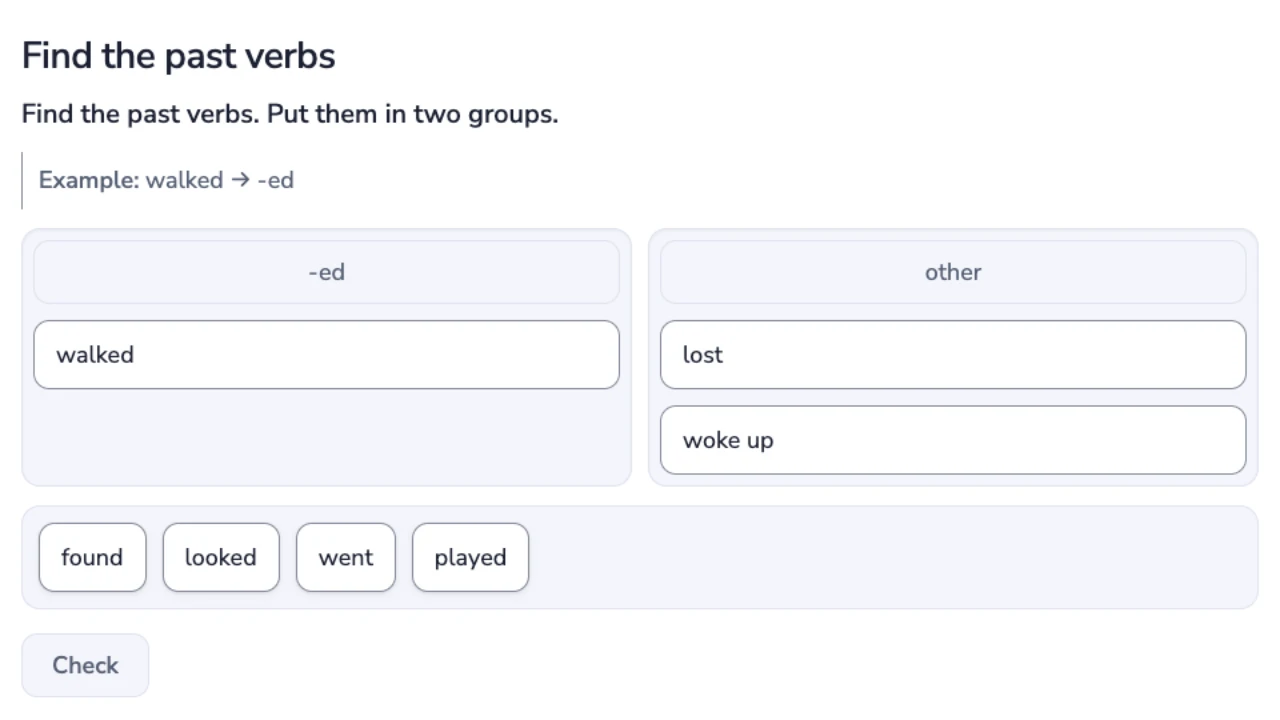
Cycle: match. At B1, sort adjectives into positive and negative: generous, stubborn, reliable, moody. At A2, sort words by their vowel sound: ship, sheep, fit, feet.
Why it works: sorting makes students think about what a word means or how it sounds, not just how it is spelled.
Group: after sorting, ask two students to explain one choice aloud. "Why is stubborn negative?" often starts a good short discussion.
Variation: sort by formal and informal: purchase / buy, assist / help, kids / children.
4. Mark the target words in a text
Cycle: meet. At B2, give a short article about remote work and ask students to find six work words: deadline, colleague, workload, promotion, flexible, commute.
Why it works: seeing a word in context ties its form to how it is used. Students notice which words travel together.
Variation: ask students to mark the words that show the writer's opinion, such as surprisingly, sadly, clearly. Or turn it into an error hunt: each sentence has one wrong word, and students tap it and write it correctly.
5. Word cards for quick retrieval
Cycle: review. From A1 to B1, show a card with a picture or a definition. The student says the word first, then turns the card to check.
Why it works: saying the word before seeing it is retrieval. Looking at the word first is just rereading.
Variation: for each card, the student makes one sentence with the word. "Umbrella. I forgot my umbrella yesterday."
6. Listen, then say the words aloud
Cycle: hear and say. At A2, students hear a word, pick the matching picture, then repeat it to you.
Why it works: sound and meaning are learned together. The speaking happens live with you, so you hear and correct it on the spot.
Variation: play a sentence and ask which target word was used. "I was exhausted after the match." Was it tired, exhausted or bored?
7. A crossword from this week's words
Cycle: use. At B1, the clues are definitions and the answers are the week's words. "A person who travels to work every day (8)" is commuter.
Why it works: going from definition to word is real recall, and spelling counts.
Variation: each student writes one clue for a partner or for you. Writing a good clue is its own vocabulary task.
8. Word families and word games
Cycle: use. At B2, build a family: decide, decision, decisive, decisively. Then ask which form fits: "She is a very ___ manager."
Why it works: one root gives several words for the effort of one, and students start to see patterns in endings.
Variation: a quick group game. You say a root such as act, and each student adds the next form: action, active, actor, react. Whoever gets stuck gives a sentence with any form instead.
9. Use the words in a short free answer
Cycle: use. At B1, ask students to write two sentences about their weekend using three target words.
Why it works: production is the hardest step and the most lasting one. As the same paper puts it, producing a word "involves deeper processing, stronger memory traces, and repeated retrieval in meaningful use".
Group: collect answers on one shared page and correct them together. Pick one sentence that uses a word well and one that almost does.
10. Review the words at the start of the next lesson
Cycle: review later. Open the next lesson with five of last week's words in a task type they have not seen with those words. If they matched them last week, now they fill gaps.
Why it works: this is spaced practice. In spaced retrieval, learners are required "to actively retrieve previously learned information rather than merely restudy it". The same paper says the exact schedule matters less than the fact that spacing happens and that recall takes effort. One small study of 30 Thai university learners also reported that retention dropped after a 60-day gap without practice. So keep coming back.
Variation: mix old and new words in the same matching task. For more openers, see our ESL warm up activities.
How these vocabulary activities look in Gomently
Everything above works with paper, slides or a whiteboard. If you want it ready to teach, here is how it looks in Gomently.
- You make a lesson by describing it in a chat, in your own words.
- You can attach your own word list as a PDF, Word or text file, or a photo of a worksheet, and Gomently builds the lesson from it.
- Language lessons use ready-made tasks: multiple choice, filling gaps, matching, putting in order, sorting, true or false, crosswords, marking words in a text, tapping a picture, listening tasks and word cards.
- Gomently can speak words and texts aloud in 7 languages, including English.
- You can add one of 63 mini-games to a lesson by asking in the chat.
- After class, Gomently prepares a report card for each student for you: what went well, what to work on, repeated mistakes, and personal homework.
- Each student's homework is written from the mistakes they made, ready for you to pass on.
Those repeated mistakes give you the words to bring back at the start of the next lesson. More for English tutors is on the English tutors page.
Find the past verbs. Put them in two groups.
Correct!
FAQ
How many new words per online lesson?
Teach a small set you can actually recycle. A rough guide: around 6 to 8 at A1 and A2, 8 to 12 at B1 and B2. If you cannot bring a word back in at least two tasks and once next lesson, the set is too big.
How do I review vocabulary without boring students?
Change the task type each time. The same five words in a match, then a gap fill, then a crossword feel like three different activities.
Do vocabulary games work for adults?
Yes, when the game makes them recall something rather than just click. See our post on online ESL games for adults.
One thing to try this week
Start your next lesson with five words from the last one, in a task your students have not seen with them. Watch which words come back easily and which do not. Those are your words for next time.