Interactive activities for online lessons that work
Fourteen interactive activities for online lessons, each with a one-to-one and small group version and level-tagged examples you can use on camera.
By Gomently Team7 min read


Cameras on, faces still, one-word answers. If that sounds like your online lessons, you are not alone. Students drift when all they do is watch and listen.
How do you keep students engaged in online lessons?
Give students something to do with their hands every few minutes, and make every student answer, not just the fastest. That is most of it.
The activities below are grouped by what they do: quick checks, sorting, matching, timed games and drawing together. Each one works one to one and in a small group, with any tool you already use. Most examples are English, so if you teach English, our page for English tutors may also help.
1. Quick check: true or false with a reason (A2–B2)
Give three statements about a short text. Say the text is about Tom, who loses his key and finds it. One statement reads "Tom found the key in the park." Students answer true or false, then justify one answer: "False. He found it in his bag."
Why it works: true or false is a low-stakes start, and the reason turns a click into a sentence.
One to one: ask for the reason every time. Group: everyone answers at once, then you discuss the ones where answers split.
Variation: each student writes one false statement for you to catch.
2. Quick check: one-question choice poll before you explain
Before you teach a form, ask one multiple choice question. At A2: "I have went / I have gone". Or: "Yesterday Tom ___ home" with went, goed and go.
Why it works: wrong options built from typical mistakes show you the misconceptions before you explain. And everyone commits to an answer.
One to one: ask why they chose it. Group: reveal answers together, then ask someone who chose "goed" what rule they used. Then explain: go is irregular.
Variation: for young learners, use pictures as options. "Tap the picture you hear."
3. Quick check: dropdown gaps as a warm-up (A1)
Start with gaps where students choose: "She ___ a cat" with have or has.
Why it works: choosing is easier than producing. It is a gentle first five minutes that gets everyone clicking.
One to one: read the finished sentences aloud together. Group: each student does the set, then you go over the most missed gap.
Variation: at B1, use typed gaps with no word bank: "Type the past form."
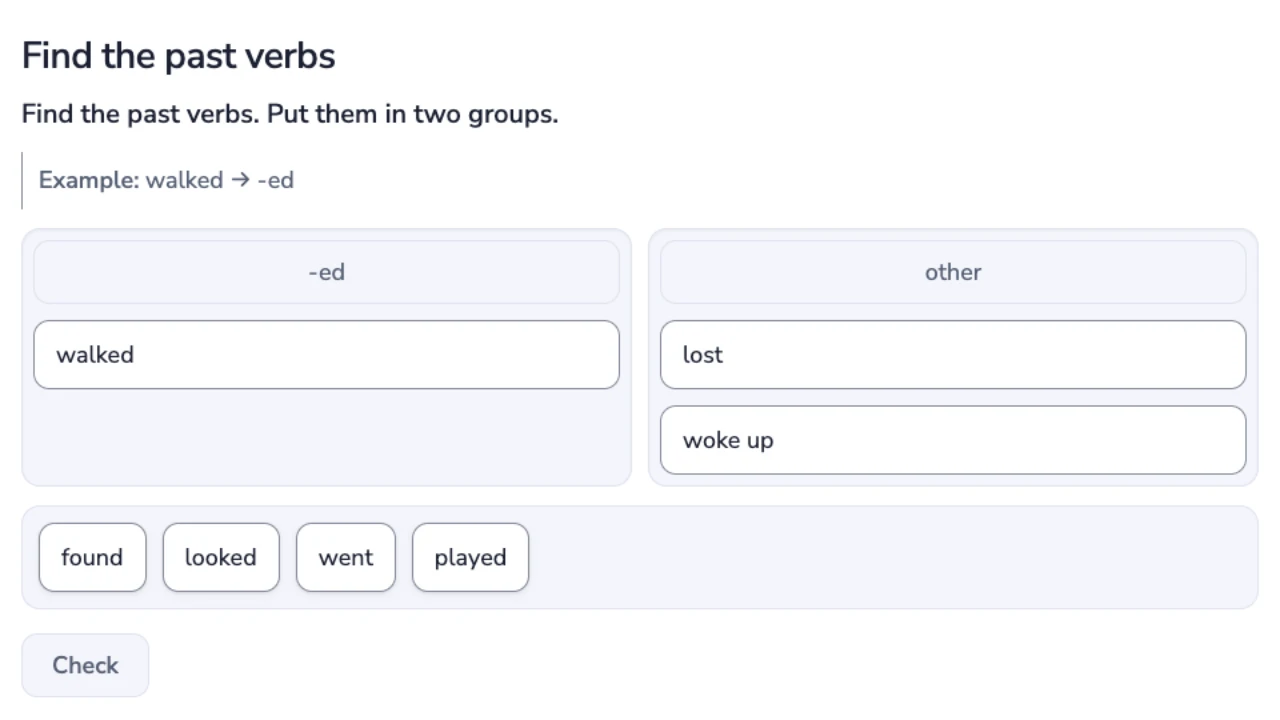
4. Sorting: two or three bins (A2)
Sort verbs into regular and irregular, or nouns into countable and uncountable.
Why it works: each item forces a decision. No one can coast.
One to one: ask the student to say each word as they sort it. Group: each student sorts alone, then you compare only the items where people disagree. Those are your teaching moments.
Variation: sort by sound: -ed endings into /t/, /d/ and /ɪd/ (walked, played, wanted). For young learners or other subjects, sort pictures: round and not round.
5. Sorting: put it in order (B1)
Give the words of a question in a jumble: "you / where / did / go / last summer". Students rebuild it. In science, order the steps of a process.
Why it works: word order becomes something you can see and move.
One to one: the student asks you the rebuilt question and you answer. Group: students ask each other.
Variation: order picture frames of a story, like a seed growing, then tell the story aloud.
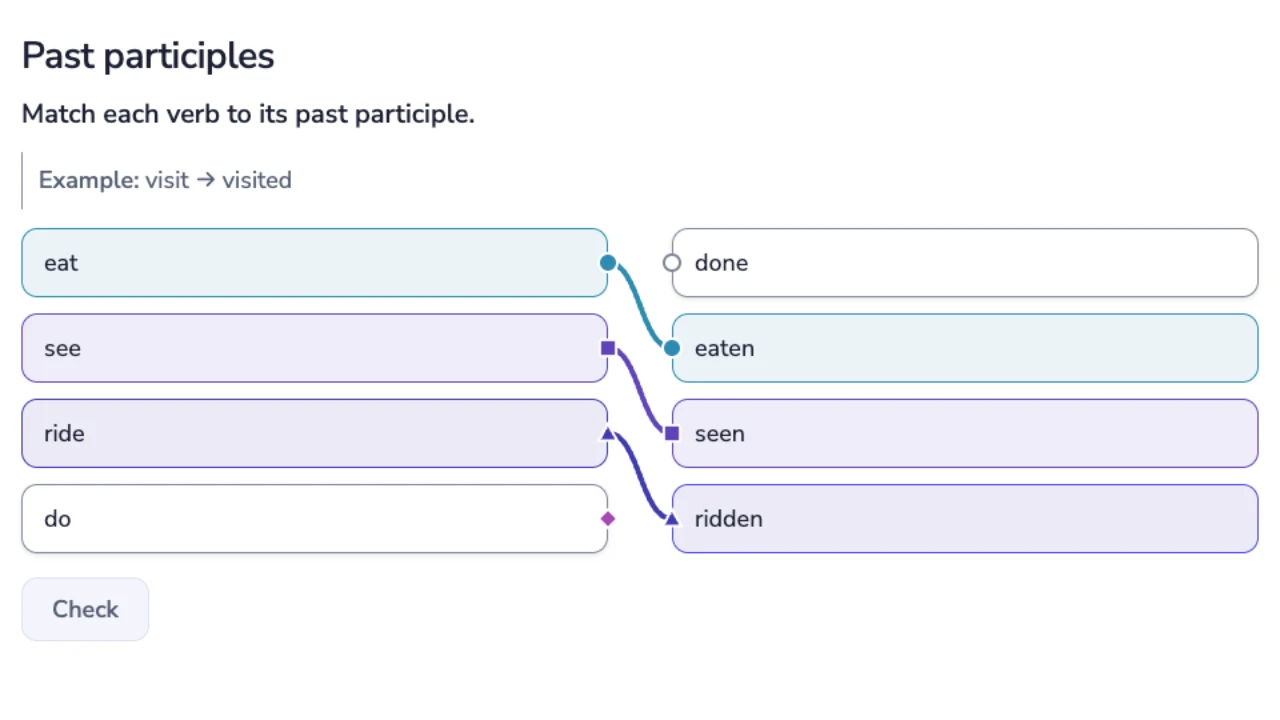
6. Matching: words to meanings or halves of sentences (B1)
Match collocations: make a decision, do homework, take a photo. Or a verb to its past form, or a word to its meaning.
Why it works: quick recall that is easy to check live.
One to one: ask for a sentence with each pair. Group: everyone matches, then each student picks one pair and uses it.
Variation: match questions to answers, then ask the questions aloud to a partner, or to you.
7. Matching: mark the words in a text (A2–B1)
Give a short paragraph and ask students to mark every past simple verb.
Why it works: students notice the grammar inside real text, not a list.
One to one: ask which verbs are irregular. Group: compare who found what, and settle doubtful ones together.
Variation: mark linking words at C1. Or run an error hunt: each sentence has one mistake, tap it and write it correctly.
8. Tap the picture (A1 and other subjects)
Show a picture and ask: "Where is the lamp?" For biology: "Tap the nucleus."
Why it works: no typing, fast, and it suits young learners who cannot type well yet.
One to one and group: same task, but in a group everyone answers before you show the answer.
Variation: the student gives the instruction and you tap. Get it wrong now and then so they correct you.
9. Timed game: beat the clock round
Take any set of tasks and add a timer, lives and points.
Why it works: a little urgency lifts the energy in the middle of a lesson, right when it dips.
One to one: the student tries to beat their own last score. Group: keep the ranking friendly and short.
Variation: a speed round of irregular verbs: you say the base form, they give the past.
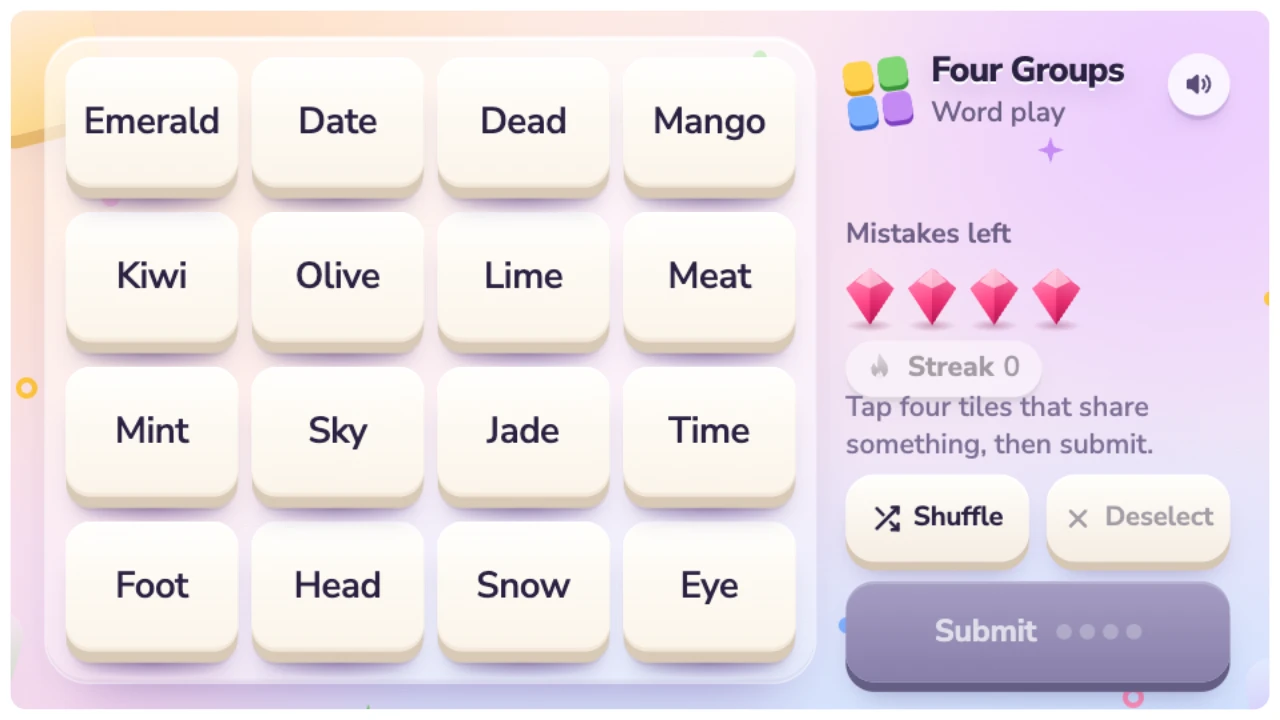
10. Timed game: four groups (B2)
Give sixteen words and ask students to find four hidden groups of four. For example, things that fly, and past forms like went, saw, flew, ran. Notice that flew fits both. That is the fun.
Why it works: students reason aloud about categories, which is real talk with a real purpose.
One to one: think aloud together. Group: let students argue for their groups before they submit.
Variation: students build a puzzle for you to solve.
11. Timed game: crossword review
Make a crossword of last week's words with definitions as clues.
Why it works: pulling words back from memory is good review, and it feels like a game.
One to one: give a hint after a short wait. Group: race in teams or solve it together.
Variation: at B1 and above, write clues in the target language only.
12. Drawing together: describe and draw (A1–A2)
Describe a room: "The lamp is next to the bed. The cat is under the table." Students draw it on a shared board.
Why it works: listening with a visible result. You see at once who understood "behind".
One to one: compare the drawing with your description line by line. Group: compare drawings and spot differences.
Variation: students describe and you draw. Your mistakes will be funny, and they will correct you with prepositions.
13. Drawing together: board brainstorm and mind map
Put a topic in the middle of a board, like "travel", and everyone writes words around it at the same time.
Why it works: quiet students contribute without having to speak first. Then you can ask them about their own word.
One to one: take turns adding words. Group: give a short time limit, then group the words together.
Variation: annotate a worksheet page together instead of a blank board.
14. Show and explain one student's answer
Put one student's answer on screen and ask them to explain their choice.
Why it works: thinking becomes visible, and attention moves around the group.
One to one: ask the student to teach the answer back to you. Group: rotate who explains.
Variation: show a common mistake anonymously and let the group fix it.
How these activities look in Gomently
You make a lesson by describing it in a chat, in your own words, and you can attach your own material. The same room works for one student or a group.
- Language lessons use ready-made tasks: multiple choice, filling gaps, matching, putting in order, sorting, true or false, crosswords, marking words in a text, tapping a picture, listening tasks and word cards.
- Each student works on the lesson on their own device, while you move the class from section to section.
- You can add one of 63 mini-games to a lesson, and turn a section into a challenge with a timer, lives and points by asking in the chat.
- A shared board lets the whole class draw and write at the same time; students change only their own marks, and only you can clear it.
- You can put one student's screen in front of the whole class and hand that student the marker.
- A live view shows who is working, done, needs help or has a hand up, and how far each student is.
The water cycle
Science · Year 5


Noor
Clouds are tiny drops of water!
The water cycle
Science · Year 5
Noor
Clouds are tiny drops of water!
See more on the features page.
One thing to try this week
Pick one lesson and add a choice poll before you explain anything new. Watch who picks the wrong answer and why. Then build the rest of the lesson around the hands-on activities above.